

As threats evolve — from quantum computing to AI-powered fault injection — this foundation should evolve with them. The design decisions made in silicon today will decide the security posture of billions of units for the following decade. As Quickly As sufficiently highly effective quantum computers exist, conventional uneven cryptographic methods for key exchange and digital signatures shall be simply damaged. New cryptographic algorithms often recognized as quantum safe cryptography (QSC) or post-quantum cryptography (PQC) are needed to protect in opposition to quantum computer assaults. Indeed, attackers are continuously finding new ways to exploit crucial vulnerabilities across a variety of applications and gadgets. Fortunately, a programmable hardware-based root of belief can be repeatedly updated to deal with an ever-increasing range of threats.

In a firmware attack, cybercriminals spot vulnerabilities within the firmware and install malware, and take management of the entire hardware. Since typical antivirus software program hardly ever scans firmware or monitors it, such types of cyberattacks are tough to detect. Securing IoT gadgets is crucial to protect the system makers popularity with shoppers and companies. More And More additionally it is https://www.zagreb-energyweek.info/leveraging-ai-iot-corporate-energy-optimization/ lined by regulation, regulation and standards so security cannot be added as an afterthought. If a microcontroller doesn’t have a Root-Of-Trust built-in, it’s potential to determine one utilizing third-party parts, trusted firmware for Cortex-M (TF-M), and so forth. Attestation allows us to ship the system an operation to perform, which it’ll then use its personal key to sign.
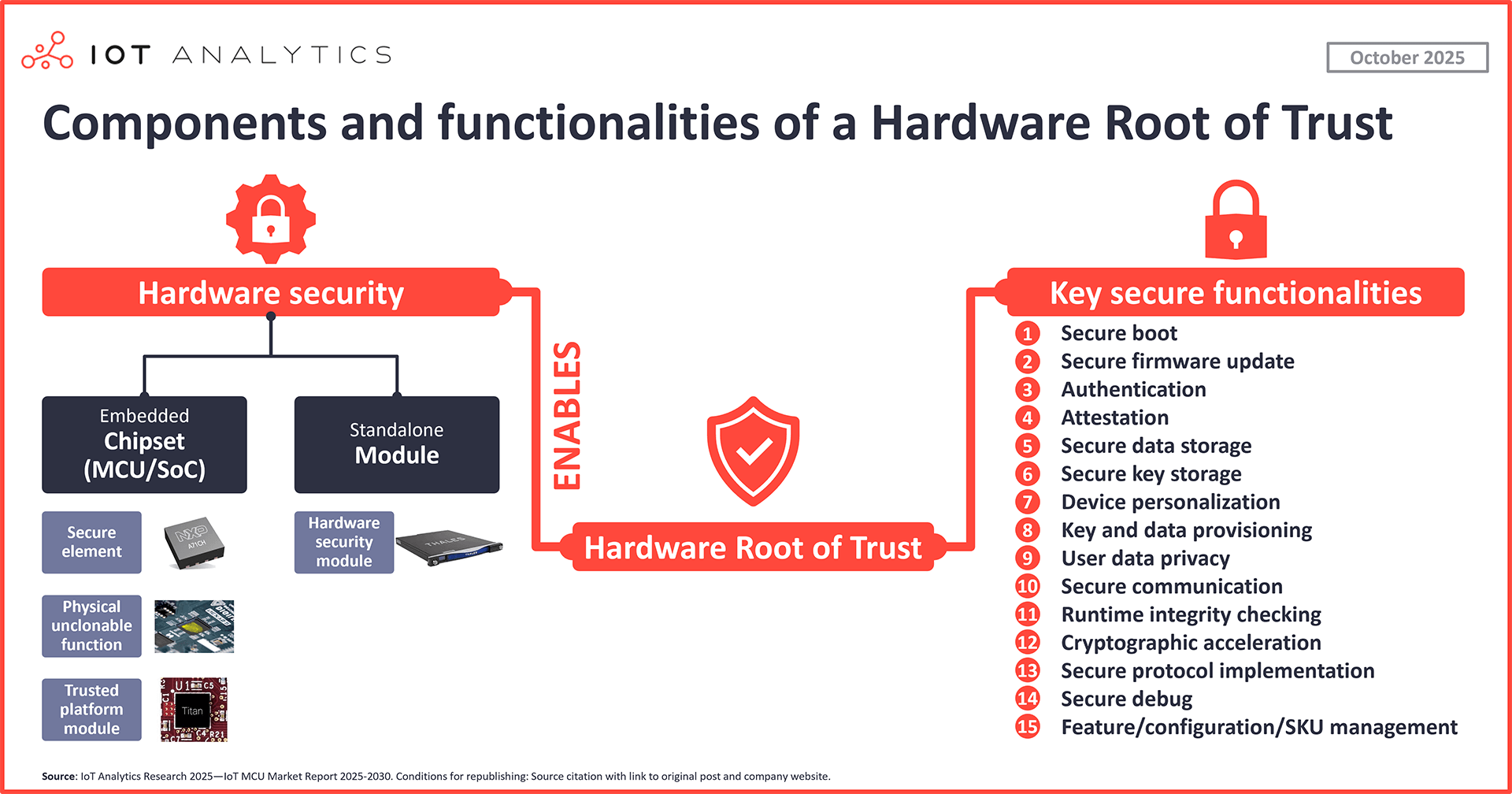
Last up to date on April 8, 2025 A root of trust is the safety foundation for an SoC, different semiconductor gadget or digital system. From our perspective, the hardware root of belief incorporates the keys for cryptographic features and is often a half of the safe boot course of offering the muse for the software chain of belief. Root of Belief schemes generally embody hardware hardening applied sciences like a hardware safety module (HSM).
Secure Key Protection
- The Root-of-Trust is used to validate all the extra items of software that load on the system and is the first foundational link in a Chain-of-Trust that successfully boots an embedded system.
- A principal example is the hardware security module (HSM) which generates and protects keys and performs cryptographic capabilities within its secure environment.
- In abstract, the hardware TPM plays a crucial function in providing a secure foundation for computing techniques.
- The Root of Belief (RoT) is a foundational security element in a computing system that may all the time be trusted.
- Once sufficiently powerful quantum computer systems exist, traditional asymmetric cryptographic methods for key trade and digital signatures shall be simply damaged.
Once within the microcontroller, we don’t need this data to be changeable. IoT units can differ widely by means of application and processor types, so there isn’t a standard methodology for implementing Root of Trust with IoT. Typically Root of Belief is secured with an HSM, but it can additionally be secured through software. Root of Belief in cellular gadgets poses a quantity of challenges, together with a larger danger of physical assaults, multiple semi-independent processors and interfaces, and energy and area constraints.
Even OTP-based Boot ROM configurations carry threat, as OTP programming interfaces can potentially be exploited. At Rambus, we create cutting-edge semiconductor and IP merchandise, providing industry-leading chips and silicon IP to make data faster and safer.
Comparable Posts
For organizations, this is the elemental threat that could destroy businesses, hamper their popularity, and result in some of the worst types of cybersecurity attacks. Talk About integration of EnsoEntropy™, hardware trust and post-quantum technology into merchandise and silicon. This chaining ensures that the ultimate PCR worth represents the whole sequence of loaded components.
Convey Your Individual Gadget (BYOD) policies pose further challenges in assuring that personally owned devices adjust to company policies. Root of Trust attacks are silent killers; they’re refined, making them a harmful threat. They’re designed to strike at the basis of our digital security stack, undermining the protection layers. Supply chain assaults exploit the vulnerabilities of an organization, which could embody internal or external vulnerabilities similar to software, hardware, or enterprise operations.
What Are The Types Of A Silicon-based Hardware Root Of Trust?
When a SoC powers on, the processor begins executing from a hard and fast address that factors into the Boot ROM. This ROM accommodates the first-stage boot code and the public key (or hash of the public key) used to verify the following stage. Root of Trust product designs vary significantly in architecture and capabilities. When deciding on a Root of Trust answer, it’s essential to ask the best questions to make sure the best level of safety in your specific safety needs. Develop the Root of Belief hardware with side-channel attacks and physical tamper-resistance protections. Root of Belief is a elementary aspect of hardware and software safety, an preliminary factor from which all other security components branch out.
The main position of a hardware TPM entails secure storage, key administration, and attestation. The PSA Root of Belief (PSA-RoT) was developed specifically for IoT and designed to assist developers looking to cost-effectively implement IoT security, even on low value microcontrollers. It offers an easy-to-use safety component implemented by many of the world’s main chip distributors. The PSA-RoT is normally offered by the chip vendor and integrated in their Software Development Kits. It is accessible to platform and system software through a excessive degree, easy-to-use software interface and consists of 9 security features designed to deal with 10 key safety objectives.
By Way Of rigorous evaluation, we establish the constraints of hardware-centric options in resource-constrained environments and discover the potential of software-centric alternate options to beat scalability and adaptability challenges. Moreover, we define open research challenges and provide design principles for growing a strong SRoT. To the best of our data, that is the only survey in the literature to holistically address each hardware and software program RoT, providing a novel contribution to the field of trusted computing and IoT safety. In summary, the hardware TPM plays a crucial position in providing a safe basis for computing techniques. It offers safe storage for cryptographic keys, supports key technology and administration, enables distant attestation, and ensures the integrity of the system by way of safe boot processes.